
This page will look at Georgia personal injury lawsuits and how much they are worth. We will provide a general overview of some critical aspects of Georgia tort law, including the types of damages plaintiffs can get under Georgia law and how long they can wait to file. We will also look at the average settlement value of Georgia personal injury lawsuits.
Under Georgia law, anyone physically injured by the negligent or reckless conduct of another person or entity is entitled to hold that person financially responsible for the “damages” caused by the injuries. Damages are intended to make the plaintiff whole by restoring them to their position before the injuries. In Georgia, personal injury plaintiffs are entitled to 3 different categories of damages:
Many states have enacted laws imposing caps on the maximum damages plaintiffs can receive in personal injury lawsuits. Georgia does not impose any damage cap for personal injury cases involving auto accidents, premises liability, products, and other injuries. In 2005, however, the Georgia legislature enacted a law imposing a limited damage cap in medical malpractice cases.
That law (GA Code §51-13-1) limits the amount of pain & suffering damages a plaintiff can get in a medical malpractice case to $350,000 from an individual defendant.
In Atlanta Oculoplastic Surgery v. Nestlehutt, 691 S.E.2d 218 (Ga. 2010), the Georgia Supreme Court refused to apply the statutory damage cap because the law violated Georgia’s state constitution. The damage cap law remains on the books in the Georgia Code, although its validity is doubtful in light of the Nestlehutt decision.
All states have laws of limitations that limit how long a plaintiff can wait to file a lawsuit. In Georgia, the statute of limitations for filing a personal injury lawsuit is 2-years from the date the claim “accrues.” GA Code § 9-3-33 If prospective plaintiffs in Georgia don’t file their injury lawsuit within the 2-year limitation period, they will be permanently barred from filing suit.
Georgia follows the “discovery rule” to determine when a “claim accrues” and the 2-year limitations period begins. Under this doctrine, a claim accrues when the plaintiff knows or reasonably should know that they potentially have a legal claim against the defendant.
In auto accident cases, the claim accrues on the accident date because any reasonable person should understand that they have a claim against an at-fault driver. In malpractice cases, however, the date when the claim accrues can be much more complicated.
There is also a ten-year statute of repose in product liability cases. Recklessness is an exception that can extend the deadline to file beyond ten years if the discovery rule applies.
The potential value of a Georgia personal injury lawsuit in a settlement or trial depends on several different factors. Still, the most crucial factor is the severity level of the plaintiff’s physical injuries. Personal injury and wrongful death lawsuits involving more serious, permanent injuries have a higher settlement value. The chart below shows average settlement values for Georgia personal injury cases based on injury level.
Several other factors significantly impact the potential value of an injury case in Georgia. The type of personal injury case (e.g., auto accident vs. medical malpractice) often makes a big difference, in part because of the amount of available insurance to cover any damages.
In many auto accident cases, for example, the value of a case is limited to $150,000 – $200,000 (or even less) because that is the maximum policy limit for auto insurance policies.
Another major factor driving the value of Georgia personal injury cases is what jurisdiction the case is in. Georgia is a state with an extensive range of socio-economic demographics. If you have a personal injury case in Atlanta or DeKalb County, it will have a much higher value because juries in these locations are more plaintiff-friendly than those in rural parts of the county.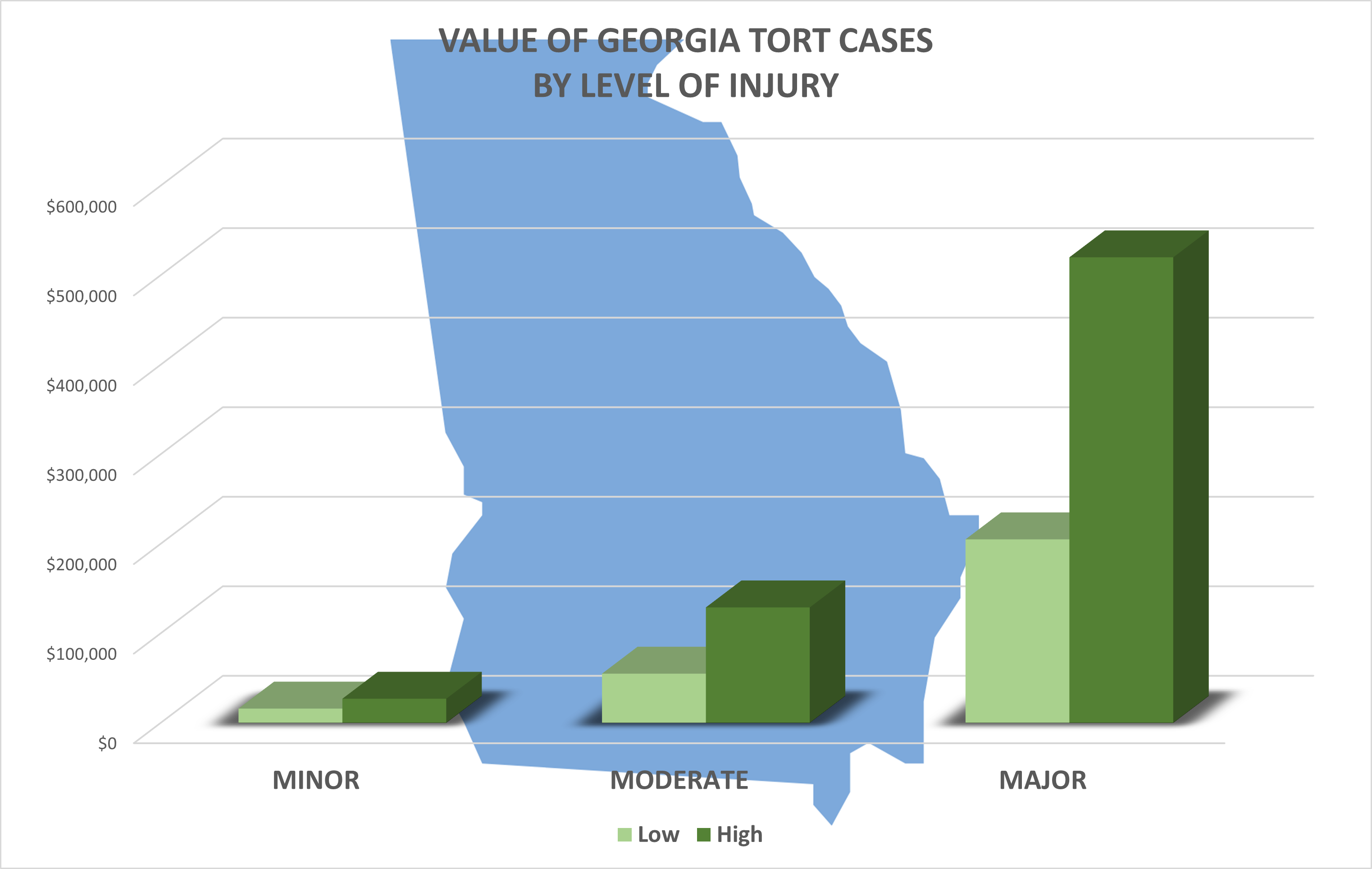
Negligent security lawsuits in Georgia are part of premises liability law, specifically focusing on cases where inadequate security measures have led to preventable harm. In Georgia, these suits often arise after criminal activities at premises such as apartment complexes, hotels, shopping malls, and parking garages.
The underlying premise of any negligent security lawsuit in Georgia is the failure of property owners or possessors to provide reasonable security measures, leading to harm or injury to an individual who was lawfully present on the premises.
Under Georgia law, landowners or occupiers must exercise ordinary care in keeping the premises and approaches safe (O.C.G.A § 51-3-1). This applies to commercial establishments, residential complexes, and other public spaces. The law further stipulates that failure to meet this standard can render the owner or occupier legally liable for any injury or harm arising from such negligence.
Georgia courts utilize a ‘foreseeability’ criterion to assess the responsibility of property owners. The premises owner may be liable if they could reasonably foresee the likelihood of a criminal act but failed to take reasonable steps to deter it. Georgia courts have long held that previous similar criminal activities could create foreseeability of the incident at hand.
Call 800-553-8082 if you are looking to maximize the jury payout or settlement amount of your personal injury claim in Georgia.


Personal injury lawyers handling serious personal injury truck and auto accident, medical malpractice and products liability cases throughout the United States.
This site is protected by reCAPTCHA and the Google Privacy Policy and Terms of Service apply.
Please do not include any confidential or sensitive information in a contact form, text message, or voicemail. The contact form sends information by non-encrypted email, which is not secure. Submitting a contact form, sending a text message, making a phone call, or leaving a voicemail does not create an attorney-client relationship.
Georgia Personal Injury Verdicts and Settlements – Lawsuit Information Center Blog

Visited 7 times, 1 visit(s) today
[mc4wp_form id="5878"]