Below is a brief review of some critical points of law related to personal injury lawsuits in Louisiana, such as how long you can wait to file a lawsuit and what damages a plaintiff can recover. We also look at Louisiana settlement amounts and jury payouts.
Here are some recent verdicts in Louisiana. These are mainly taken at random. Please don’t assume they are proof positive about the value of your claim. But I think they are illustrative.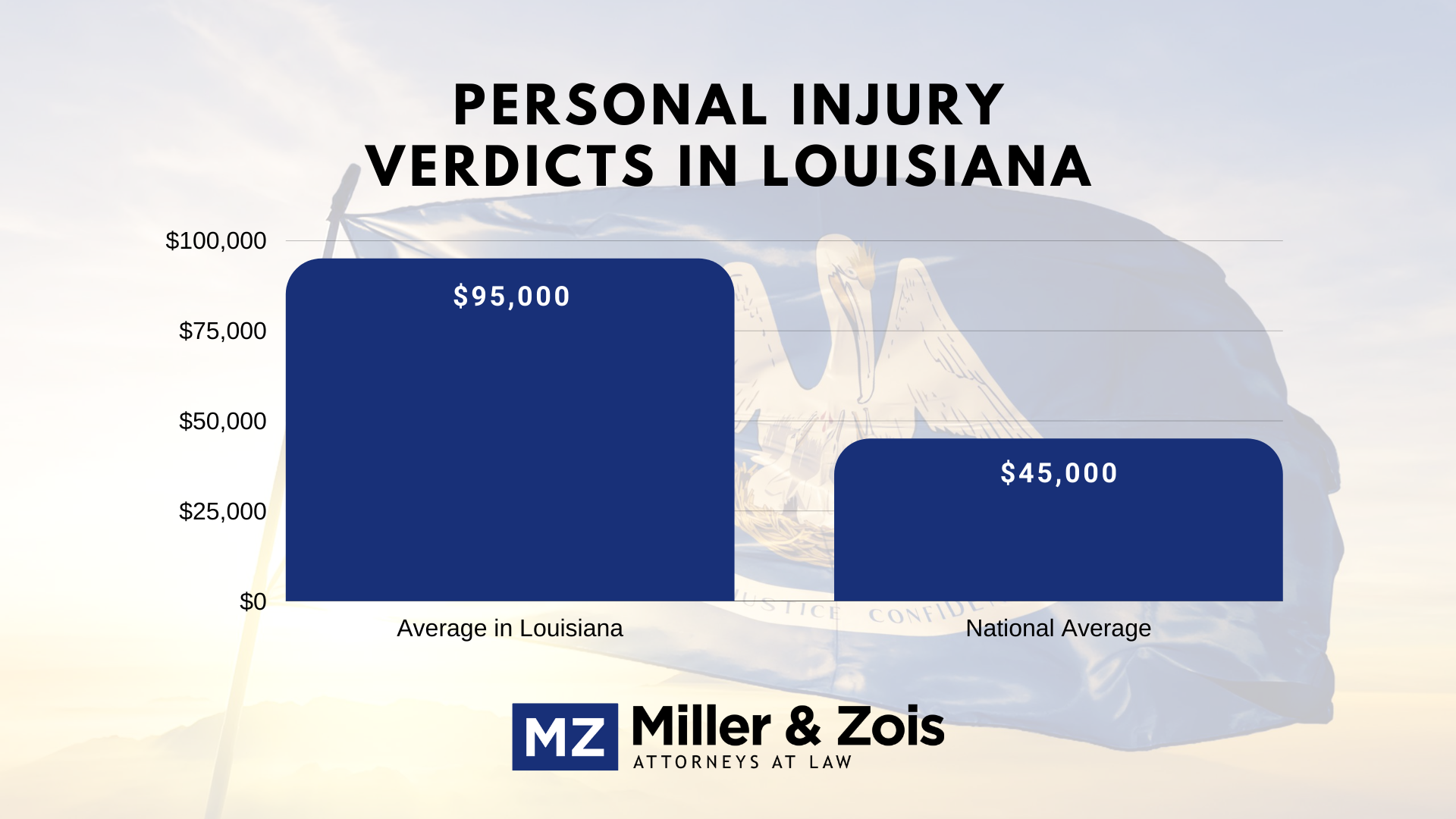
Below is a summary and description of some of the key personal injury laws in the state of Louisiana.
In Louisiana, the statute of limitations for most personal injury cases is one year from the date of the accident or injury. See La. Civ. Code, art. 2321. This means that a plaintiff must file a lawsuit within that time frame, or they may lose their right to pursue a claim. There are some exceptions to this rule (such as if the plaintiff is a minor), so it’s essential to consult with an attorney to determine the specific deadline for your case.
So when does the 1-year statute of limitation period begin? The critical question in a statute of limitations analysis is when the applicable period (in La. 1 year) begins to run. Like most states, Louisiana follows the so-called discovery rule for determining when its 1-year SOL period begins. Under this rule, the 1-year period begins when the plaintiff reasonably should have discovered that they had a potential legal claim.
In simple auto accident cases, the 1-year period begins to run on the accident date because any reasonable person who gets in a car accident would know that they could potentially have a claim. In more complex cases, such as medical malpractice, however, the date of discovery can be much later. For example, if a doctor fails to diagnose cancer, the 1-year statute of limitation period would begin to run when the plaintiff discovers the misdiagnosis, not when the doctor made the diagnosis.
Until recently, sexual abuse civil lawsuits in Louisiana were subject to a 3-year statute of limitations. In 2021, however, Louisiana joined a growing number of states across the country that amended their laws to make it easier for victims of child sex abuse to file civil lawsuits years later. The new law, which was signed into law in June 2021, eliminated the statute of limitations for sexual abuse civil lawsuits in the future. It also created a 3-year window for victims of prior sexual abuse to file civil lawsuits no matter how many years have passed.
Under Louisiana’s new law, future sexual assault victims will not be subject to any statute of limitations period. This means that you can file a civil lawsuit against your abuser or a school or organization that enabled the abuse no matter how many years have passed since the incident occurred. For past abuse that occurred prior to August 1, 2021, victims have until August 1, 2024 to file a civil lawsuit without any statute of limitations application.
Louisiana has a $500,000 cap on damages certain types of damages that a plaintiff can get in a medical malpractice case. This cap does not apply to economic damages such as lost wages or medical expenses. It only limits the amount a plaintiff can get for pain & suffering (non-economic damages). There is no cap on damages for other personal injury cases, such as car accidents, slip and falls, or product liability claims.
Louisiana follows a modified comparative fault law system, which means that a plaintiff can still recover damages even if they were partially at fault for an incident. Their percentage of fault will reduce the extent of the plaintiff’s recovery.
For example, if a plaintiff was found to be 25% at fault for a car accident, their recovery would be reduced by 25%. This means that if the plaintiff was awarded $100,000 in damages, their recovery would be reduced to $75,000.
But if a plaintiff is found to be more than 50% at fault for an incident, they will not be able to recover any damages. Comparative fault law in Louisiana operates on a threshold system, where a plaintiff’s recovery is only reduced if they are less than 50% at fault for the incident.
The Louisiana Medical Malpractice Act governs medical malpractice claims in Louisiana. Before filing a lawsuit, a plaintiff must present their claim to a medical review panel, which will issue an opinion on whether the healthcare provider’s conduct met the standard of care. If the panel finds a breach of the standard of care, the plaintiff can proceed with the lawsuit.
Under §1237.2, Louisiana law has a process for reviewing malpractice claims against the state, its agencies, or other covered parties in Louisiana. A state medical review panel must first review malpractice claims before any action can be taken in court.
So under the Louisiana Medical Malpractice Act (LMMA), any claim of medical malpractice levied against a private, qualified healthcare provider will be deemed premature and subject to dismissal unless it has first undergone review by a medical panel. “Malpractice”, as defined by the LMMA, refers to any accidental tort or any contract breach that pertains to healthcare or professional services that a healthcare provider has either rendered to a patient, or should have rendered. This includes failure to provide services in a timely manner, mishandling of a patient (which includes patient loading and unloading), as well as any legal responsibility a healthcare provider may hold due to acts or omissions occurring during the procurement of blood or blood components.
The review panel consists of one attorney and three healthcare providers. A filing fee of $100 per named defendant state health care provider must be paid within 45 days of the request for review unless waived by submitting an affidavit from a physician certifying that adequate medical records have been reviewed or receiving an in forma pauperis ruling from a district court. The filing of a request for review suspends the time within which a lawsuit must be filed until 90 days after notification of the panel’s opinion. If the panel does not render an opinion within 12 months, the parties may petition for an extension, but the panel is dissolved after that time. Parties may waive the use of the review panel.
In Louisiana, dog bite cases are governed by strict liability laws, which means that a dog owner may be held liable for damages even if they were not negligent or at fault for the incident. This means that if a dog bites a person, they can hold the dog owner responsible for their injuries without having to prove that the owner was careless or acted improperly.
Under Louisiana law, a dog owner is strictly liable for damages if the victim was bitten while in a public place or while lawfully on private property, including the property of the dog owner. This means that the dog owner can be held liable even if the victim was not an invited guest on their property (and homeowner’s insurance may still cover the loss).
However, there are some exceptions to strict liability for dog bites in Louisiana. For example, if the victim was trespassing on the dog owner’s property, the owner may not be held strictly liable for the bite. Additionally, if the victim provoked the dog, the owner may be able to defend against a claim for damages.
Other rules relating to personal injury law and action in Lousiana can be found in the following section of the Lousiana Revised Statutes:
There are a variety of national mass torts or “class actions” that involve hundreds of Lousiana plaintiffs, including claims our law firm is handling across the country:
Victims of child sexual abuse in Louisiana can file civil lawsuits against the individual abusers and the organizations that allowed the abuse to occur. New laws in Louisiana have recently made it much easier for child sex abuse victims to get financial compensation by bringing a sexual abuse civil lawsuit against churches, schools, and other institutions for negligently failing to protect them from abuse or failing to stop it. The new child sex abuse laws in Louisiana prompted the Archdiocese of New Orleans to file for Chapter 11 bankruptcy. There are now over 500 claims filed in the New Orleans Archdiocese bankruptcy.
At our law firm, we focus on handling serious injury and wrongful death cases. Our personal injury attorneys collaborate with reputable colleagues in Louisiana and cover the fees for those lawyers through our own attorney fees. This means that you won’t have to pay any extra contingency fees for working with two law firms, and you’ll only be responsible for paying a fee if you receive compensation from a settlement or jury award.
If you’ve been injured and believe you have a valid civil tort claim, don’t hesitate to reach out to us. Call 800-553-8082 or get a free online consultation.


Personal injury lawyers handling serious personal injury truck and auto accident, medical malpractice and products liability cases throughout the United States.
This site is protected by reCAPTCHA and the Google Privacy Policy and Terms of Service apply.
Please do not include any confidential or sensitive information in a contact form, text message, or voicemail. The contact form sends information by non-encrypted email, which is not secure. Submitting a contact form, sending a text message, making a phone call, or leaving a voicemail does not create an attorney-client relationship.
Louisiana Personal Injury Law and Settlements – Lawsuit Information Center Blog
Visited 3 times, 1 visit(s) today
[mc4wp_form id="5878"]