
This page explores settlement amounts and jury awards in personal injury cases in Texas. Our attorneys also do a deep dive into Texas personal injury law to help you better understand the lay of the land when bringing a personal injury claim in Texas.
If you’re a personal injury victim filing a compensation claim in Texas, you should want to know the potential range of settlement payouts for your case. Why? Because monetary compensation is ultimately what a personal injury or wrongful death claim is all about. The purpose of the system is to put a dollar amount on your suffering. Because that is all the civil justice system can provide for you.
This page is designed to survey how personal injury cases have been resolved in Texas, offering you the opportunity to align your claim with Texas personal injury settlement statistics and example settlements and jury awards.
Tread lightly here. Drawing parallels between two seemingly similar cases and expecting similar outcomes is a fool’s errand. No two cases are identical, and sometimes, the factors that influence the settlement payout of a case are not readily apparent from a case summary. So why do we provide these to you? Examining comparable cases and statistics provides more insight into your injury claim’s potential value.
A Jury Verdict Research computed the average verdict in a personal injury lawsuit in Texas is $826,892. But Texas is a particular example of the differences between the median and average jury verdicts: the median award is just $12,281. You can always drive a truck between the difference between average jury verdicts and median jury verdicts. But in Texas, a fleet of trucks would not cover this gap.
Why the gap? Huge verdicts also distort the average. A Texas jury awarded $118 million – the highest verdict included in this Texas jury verdict study – to the widow of a worker who died in the Phillips Petroleum Co. explosion. Still, the Texas cap on punitive damages reduced that award to under $12 million.
Texas has taken harsh steps to curb malpractice cases to the point where few are filed in 2023 that are not birth injury lawsuits. These caps limit the pain and suffering awards on health care negligence cases to $250,000 against doctors and $250,000 per facility but capped at $500,000. So there is a $750,000 overall cap, only in cases where the stars line up and you have multiple defendants. It is a tough road. Motor vehicle crash claims make up a more significant portion of the verdicts.
This is a list of recent verdicts in the Lone Star state. Can you use these to help you determine the compensation in your case? Yes and no. They are helpful, to be sure, which is why I’m putting them up. But take them with a grain of salt. Every case is different, and sometimes there are facts not even listed in these summaries that make all the difference in these cases.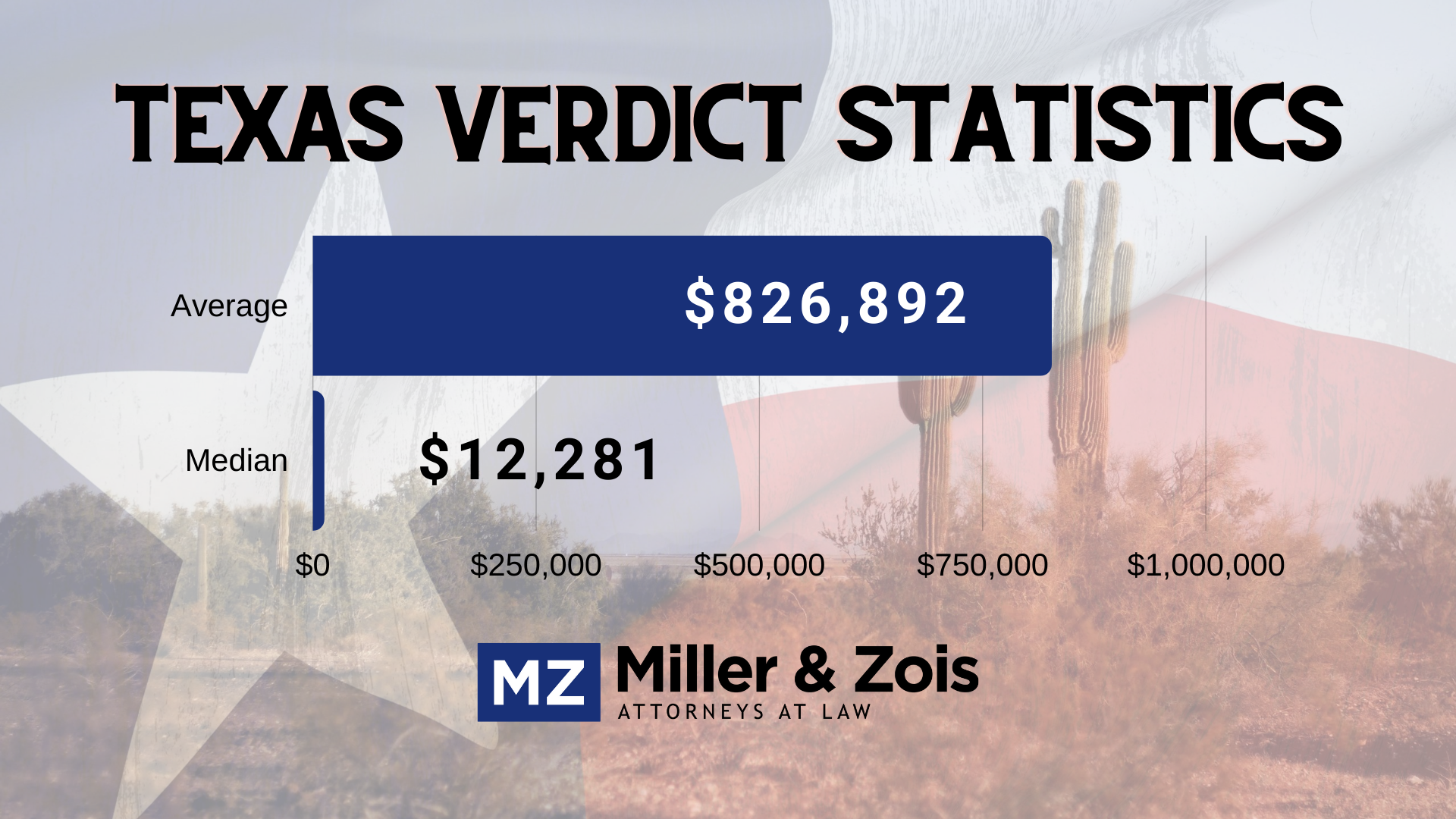
Below is a summary of some key points relating to Texas’s personal injury and malpractice lawsuits.
Every state has a statute of limitations that sets a legal time limit on how long plaintiffs can wait to file civil lawsuits. The applicable statute of limitations and time frame can vary depending on the type of personal injury case involved.
All personal injury lawsuits in Texas are subject to a 2-year statute of limitations. Tex. Civ. Prac. & Rem. Code § 16.003. If you have a potential injury lawsuit, you must file your case within two years of when the “cause of action accrues,” or your case will be legally barred. Your right to file a lawsuit will be lost forever.
The key to the Texas statute of limitations is understanding when the 2-year SOL period begins to run. The 2-year period starts when the “cause of action accrues.” In Texas, the cause of action accrues when a wrongful act causes an injury. In a simple car accident case, the cause of action accrues on the accident date.
But what about in more complex circumstances where the plaintiff does not learn about their injury or the wrongful conduct until later (e.g., a misdiagnosis malpractice case)? Most states follow something called the discovery rule, which says that the cause of action only accrues once the plaintiff discovers or reasonably should have discovered the injury and their potential claim.
Texas only allows a very limited version of the discovery rule. The Texas Supreme Court has recently held that the discovery rule is a narrow exception that should only be applied in “exceptional cases” where the injury is “inherently undiscoverable.” Berry v. Berry, 646 S.W.3d 516 (Tex. 2022). See also Prince Weleba (Tex. 2023)
Medical malpractice cases in Texas are also subject to a two-year statute of limitations. The two-year clock begins running on the date the malpractice occurred. Tex. Civ. Prac. & Rem. Code § 74.251. The 2-year SOL clock begins running on the date the malpractice occurred. If the medical malpractice occurred as part of a course of continuous medical treatment, the 2-year SOL period usually begins to run on the last day of that treatment.
The 2-year SOL for malpractice cases applies regardless of whether the plaintiff knew or should have known about the medical negligence. However, certain exceptions, such as fraudulent concealment, can extend the date when the 2-year period begins to run.
In addition to the 2-year statute of limitations, medical malpractice lawsuits in Texas are also subject to a statute of repose. The statute of repose is like a maximum deadline for filing malpractice claims, regardless of fraud or when the claim was discovered. The Texas statute of repose for malpractice cases is ten years.
In Texas, wrongful death lawsuits are governed by Chp. 71 of the Civil Practice and Remedies Code. The statute allows damages to be recovered when a person’s death is caused by negligence, intent, or another wrongful act.
The plaintiffs entitled to bring a wrongful death case in Texas include the decedent’s immediate family members (e.g., spouse, children, parents, siblings). The personal representative of the decedent’s estate may also bring a wrongful death claim. Any damages or settlement proceeds in a wrongful death case are distributed among the surviving family members according to specific rules.
Wrongful death cases in Texas must be filed within 2-years of the date of death. There are very limited exceptions to this SOL for wrongful death claims.
Texas has adopted a modified comparative negligence rule in personal injury cases in which the plaintiff is partly at fault for their own injuries. Under this rule, the amount of damages a plaintiff will be entitled to will be reduced by the plaintiff’s percentage share of fault. So if the plaintiff is 20% at fault, their damages will be reduced by 20%. However, if the plaintiff’s fault percentage exceeds 50%, they will be completely barred from recovering damages.
Texas Tort Claims Act (TTCA): The TTCA waives sovereign immunity for certain types of lawsuits against the state, its agencies, and its employees. The TTCA allows individuals to sue the state for personal injury, death, or property damage caused by the negligence of a state employee acting within the scope of their employment. The TTCA applies to cases involving the use of motor vehicles, dangerous conditions of real property or tangible personal property, and the use of specific equipment or materials.
There a caps on damages with a TTCA claim. The maximum amount that can be recovered from the state for a single occurrence is $250,000 per person and $500,000 per occurrence for personal injury or death. For property damage, the maximum recovery is $100,000 per occurrence.
There is also a notice requirement that is a huge deal. Too many people miss on their ability to bring a claim because they miss the notice requirement in the TTCA. Before filing a lawsuit against the State of Texas, a claimant must provide written notice of the claim within six months of the incident. The notice must include details such as the time, place, and circumstances of the injury and the amount of damages claimed.
Medical lawyers in Texas a hard to find. Why? Tort Reform. In 2003, Texas enacted significant tort reform measures to address alarms being sounded about the rising costs of medical malpractice insurance premiums in Texas. This legislation, called House Bill 4 (HB 4), included several provisions that made it more difficult to file and win medical malpractice lawsuits in Texas.
The most painful provision of HB 4 was the establishment of draconian caps on non-economic damages, such as pain and suffering, in medical malpractice cases. The cap was set at $250,000 per defendant, with an overall cap of $750,000 for all defendants in a single case. So you understand, this means if a small child is rendered a quadriplegic, the most that child will get for a lifetime of pain and suffering may be $250,000.
The caps do not apply to economic damages, so birth injury lawsuits remain viable in Texas. The future damages in these cases can drive damages in the tens of millions. But an old person with no lost income or other significant economic damages? This is not a viable malpractice claim in Texas because the cost of the lawsuit does not justify the upside of a $250,000 verdict.
Under Texas law, healthcare providers who render emergency medical care are held to a higher standard of proof in malpractice cases. To successfully sue a healthcare provider for malpractice in an emergency setting, a plaintiff must prove “willful and wanton negligence” by the provider rather than the typical “ordinary negligence” standard. This means a plaintiff must demonstrate that the provider acted with conscious indifference or reckless disregard for the patient’s safety. This rarely happens. Medical malpractice lawsuits are almost invariably about negligence.
Some nuances to Texas law provide rare exceptions when it comes to some emergency room malpractice cases. There is, for example, a distinction between a hospital emergency room and a freestanding ER, which only applies in a legitimate medical emergency. But it still stops most legitimate emergency room lawsuits in Texas from ever making it to the courthouse steps.
Texas has adopted the “loser pays” rule in medical malpractice cases, meaning that the losing party may be required to pay the winning party’s legal fees. This adds an element of financial risk for plaintiffs and their attorneys. This makes Texas medical malpractice lawyers even more selective in the lawsuits they can pursue.
HB 4 also imposes stricter requirements for expert reports in medical malpractice cases. Within 120 days of filing a lawsuit, the plaintiff must provide an expert report that details the standard of care, how the defendant breached that standard, and how the breach caused the plaintiff’s injury. This is burdensome but not uncommon in other states, unlike other Texas malpractice laws.
In Texas, medical malpractice claims are governed by specific procedural requirements, including the notice requirement. Before filing a medical malpractice lawsuit against a healthcare provider, a claimant must provide written notice of their intent to file a claim. This requirement is outlined in the Texas Medical Liability Act, specifically in Texas Civil Practice and Remedies Code § 74.051.
According to the notice requirement:
To move forward with a healthcare liability claim, the Texas Medical Liability Act (TMLA) mandates that a claimant adhere to the Act’s stipulations for serving expert reports. Specifically, the claimant must provide each named healthcare liability defendant in the lawsuit with an expert report, accompanied by the expert’s curriculum vitae within 120 days following the filing of the defendant’s answer.
Like the notice expert report requirement in Texas, this notice requirement is burdensome for Texas malpractice lawyers but this is small potatoes compared to the door-shutting barrier we talk about above.
In Texas, the defendant can’t introduce evidence that the plaintiff received compensation for the injury from other sources, like insurance. So the rule that prevents multiple compensations for the same loss doesn’t apply if one of the compensations is an insurance payment covered by the collateral source rule. However, there are exceptions in some medical malpractice cases. The rule also does not apply to payments made by the defendant’s own insurance company. Additionally, the rule may not apply if the plaintiff received payments from a collateral source but did not actually mitigate their damages (for example, if they did not seek medical treatment for their injuries).
In Texas, healthcare professionals are mandated to clearly inform their patients about the potential risks and outcomes of medical interventions before proceeding. They need to convey this information in a manner that ensures the patient fully grasps the implications. Simply signing a document does not do that.
Outlined in Subchapter C of Chapter 74 of the Texas Civil Practice and Remedies Code, the Texas Informed Consent Statute specifies the essentials of informed consent. According to this law, prior to any medical procedure, healthcare professionals must educate the patient about:
Additionally, patients should be granted adequate time to raise any queries and discuss the intervention at length. Only after acquiring a well-informed consent from the patient should the healthcare professional proceed with the treatment.
In situations where informed consent isn’t obtained, patients retain the right to instigate a medical malpractice lawsuit against the concerned healthcare provider. For a successful claim, patients need to establish:
Of course, the obligation to obtain informed consent isn’t unyielding. Exceptions exist in emergencies or if the patient is not able to provide consent. Nonetheless, the onus is on the healthcare provider to justify such exceptions.
Just like in every state in the U.S., there are a host of product liability and mass tort lawsuits being filed by Texas residents, including cases that our national mass tort law firm is handling across the country:
Our firm handles severe injury and wrongful death lawsuits in Texas. We are a national law firm that partners with lawyers in Texas to work to maximize the settlement amounts of personal injury cases.
How much more does it cost you to have two law firm working for you instead of one? Zero. We cover the costs of your Texas lawyers – and we ensure we’re working with the best – from our own attorney’s fees. You are not charged any additional contingency fees for the involvement of two law firms instead of one. Just as importantly, you only owe a fee if you receive settlement compensation or a jury payout.
If you’ve suffered an injury and believe you may have a viable civil tort claim, contact us today at 800-553-8082 or get free no-obligation consultation online.
Comments are closed.


Personal injury lawyers handling serious personal injury truck and auto accident, medical malpractice and products liability cases throughout the United States.
This site is protected by reCAPTCHA and the Google Privacy Policy and Terms of Service apply.
Please do not include any confidential or sensitive information in a contact form, text message, or voicemail. The contact form sends information by non-encrypted email, which is not secure. Submitting a contact form, sending a text message, making a phone call, or leaving a voicemail does not create an attorney-client relationship.
Texas Personal Injury Settlement Amounts and Statistics – Lawsuit Information Center Blog

Visited 1 times, 1 visit(s) today
[mc4wp_form id="5878"]