Jury Verdict Research recently released a new study looking at Michigan’s average personal injury awards: $1,089,638. As always, personal injury verdicts conflate the average; Michigan’s median personal injury compensation award is $99,506.
Interestingly, plaintiffs receive a financial recovery in 44% of personal injury lawsuits that go to trial compared to the national average of 52%. These numbers are misleading because the type of case greatly affects the average recovery and the plaintiffs’ success rate.
But this data from Michigan and this settlement and verdict info are still undeniably interesting to personal injury lawyers and accident and malpractice victims in Michigan.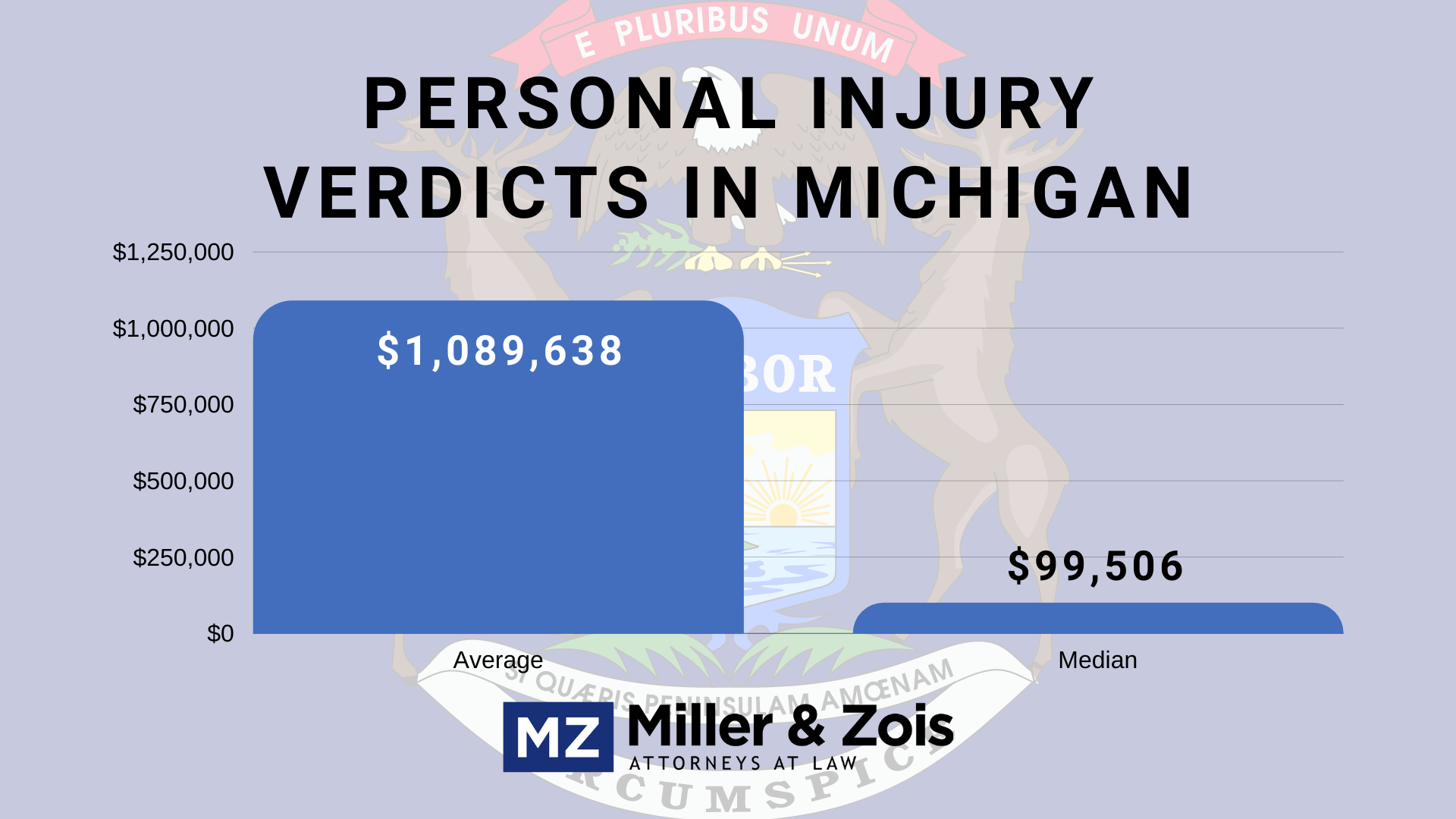
The following are some recent Michigan personal injury verdicts and settlements:
This section will provide a general overview of Michigan law in personal injury cases such as medical malpractice, auto accidents, and product liability claims.
Statute of Limitations in Michigan Injury Cases
All states have statute of limitation laws that establish time limits on how long a potential plaintiff can wait before taking action and filing a lawsuit for a personal injury case. Michigan has its own statute of limitations that sets legal deadlines for filing tort lawsuits. If the plaintiff does not file their case before these deadlines expire, they will be permanently barred from filing. The statute of limitations in Michigan is slightly different for medical malpractice cases vs. auto accidents and other personal injury claims so that we will look at those separately.
2-Year Statute of Limitations for Michigan Malpractice Cases
Under Michigan law, all medical malpractice lawsuits must be filed within 2-years of a negligent act by the health provider that gives rise to the claim. Mich. Comp. Laws § 600.5805(6). Mi
However, Mich Comp. Laws § 600.5838a(2) adopts a modified version of the discovery rule. Under this modified rule, if the general 2-year SOL has already expired, the discovery rule can be applied but only gives the plaintiff a six month extension to file. In other words, if more than 2-years pass before the plaintiff first “discovers” (or reasonably should have discovered) that they have a malpractice claim, they will have 6-months to file a lawsuit.
Regardless of the application of the discovery rule, however, Michigan law requires that all medical malpractice claims must be filed within 6 years of the act (or failure to act) giving rise to the claim. Although this is not a statute of repose, it effectively acts like one. The only exceptions to this six year maximum limit are if the health care provider fraudulently concealed the malpractice, or if the injury involves permanent damage to the claimant’s reproductive system. Exceptions to these SOL deadlines also apply in cases where the potential plaintiff is a minor (under 18) at the time of the injury.
Personal injury lawsuits in Michigan (except for medical malpractice lawsuits against licensed healthcare professionals) are subject to a 3-year statute of limitations. Mich. Comp. Laws § 600.5805. The statute says that “the period of limitations is 3 years after the time of the death or injury for all actions to recover damages for the death of a person, or for injury to a person or property.”
This means that you only have 3 years to file a personal injury lawsuit in Michigan or your claim will be time-barred. When does the three years SOL period begin to run? In most cases, the 3-year period under the statute of limitations begins to run whenever the plaintiff’s injury occurs. In an auto accident case, this will always be the accident’s date. However, Michigan does recognize the discovery rule, under which the SOL period would not be until the plaintiff first discovers (or reasonably should have discovery) that someone else’s negligence caused their injury.
The Michigan governmental immunity doctrine, outlined in the Governmental Tort Liability Act (GTLA), MCL 691.1401 et seq., shields the state government and its agencies from tort liability. This immunity is derived from the outdated but still with our concept of “sovereign immunity.” This is the idea that the government cannot be sued without its consent.
In Michigan, the GTLA grants immunity to the state, its political subdivisions, and its employees when they engage in “governmental functions.” As defined by the GTLA, a governmental function is an activity “expressly or impliedly mandated or authorized by the constitution, statute, local charter or ordinance, or other law.” MCL 691.1401(a). This broad definition encompasses various activities, making it difficult for plaintiffs to bring tort claims against the state government successfully.
Despite the general immunity granted by the GTLA, in most tort claims Michigan personal injury lawyers handle, there is a path to suing the state of Michigan for the conduct of its agents and employees. The most notable exceptions are:
To pursue a tort claim against the state government in Michigan, a plaintiff must follow a specific process, which includes:
Comparative negligence is a legal principle that apportions fault among multiple parties involved in an accident or injury. This concept is particularly relevant in personal injury cases, where the plaintiff and defendant’s actions may have contributed to the harm suffered.
In Michigan, the doctrine of comparative negligence, also known as modified comparative negligence, is followed to determine the allocation of fault and the recovery of damages. This doctrine in Michigan is governed by the Mich. Comp. Laws § 600.2959 which codified a Michigan Supreme Court ruling.
Under this doctrine, the fault of each party is assessed, and damages are apportioned accordingly.
Michigan follows a “modified” comparative negligence rule, which means that a plaintiff can recover damages only if their degree of fault is less than 50%. If the plaintiff’s fault is found to be 50% or more, they are barred from recovering any damages. Furthermore, if the plaintiff’s negligence is less than 50%, their damages will be reduced in proportion to their degree of fault.
For example, if a plaintiff suffers $500,000 in damages and is found to be 20% at fault, their recovery will be reduced by 20%, leaving them with a $300,000 jury payout. But that fault number has to be under 50% under the modified rule. So if the plaintiff is found to be 50% or more at fault, they will not recover any damages.
Michigan is among the minority of states that follow a “no-fault” system for auto accident cases. This means that for most auto accidents in Michigan, your own insurance company pays for your own damages regardless of who was at fault for causing the accident. So even if you innocently sit at a red light waiting for children and puppies to cross the street when you get recklessly rear-ended, you would probably have to use your insurance to cover the accident.
The only way to go outside of Michigan’s no-fault accident rules is if the auto accident results in severe injuries and/or death. When the accident results in severe, permanent injuries or death, then Michigan law allows you to go after the at-fault driver and their insurance for damages just like you would in a state that follows a tort system. What qualifies as a severe injury for these purposes under Michigan law is somewhat ambiguous.
Michigan has adopted strict liability in injury cases involving dog bites. Mich. Comp. Laws § 287.351 Under the strict liability rule, a dog owner is liable for damages even if they had no prior knowledge of the dog’s dangerous propensities or had no reason to believe the dog would bite.
To establish a claim under the dog bite statute, the plaintiff must prove three elements:
If these elements are satisfied, the dog owner is generally liable for the plaintiff’s damages, regardless of the owner’s knowledge or negligence.
Like most states, Michigan has enacted special laws and procedural rules that apply in medical malpractice lawsuits against licensed healthcare providers. Licensed healthcare providers include doctors, nurses, hospitals, and many other healthcare professionals.
Before filing a lawsuit for medical malpractice in Michigan, all plaintiffs must file a Notice of Intent to File Suit (NOI). The NOI must be in writing and be formally served on all healthcare providers named defendants in the case. The NOI must be served at least 182 days before the malpractice lawsuit is filed.
Serving the NOI tolls the statute of limitations for 182 days. However, if the NOI does not comply with all of the statutory requirements, the 182-day tolling period is void and the claim can be dismissed if filed beyond the statute of limitations deadline.
Michigan law requires all medical malpractice cases to be supported by an affidavit of merit from a qualified medical expert under state law. The medical expert who provides the affidavit must be a doctor or healthcare professional practicing or teaching in the same specialty or field as the defendant. The expert must also have the same board certifications as the defendant. So, this rule would prevent a general practitioner from giving an expert opinion in a medical malpractice case against a neurologist or surgeon.
The affidavit of merit must state the expert has reviewed the medical records and facts of the case. It must also certify that in the expert’s opinion, a breach of the applicable standard of medical care occurred in the case (i.e., the defendants were negligent).
Michigan law has a maximum cap on the amount of non-economic damages a plaintiff can be awarded in medical malpractice cases. Non-economic damages are better known as pain and suffering damages. The non-economic damages cap is currently $470,000 but is adjusted upward for inflation each year.
In cases where the plaintiff suffers from permanent paralysis (hemiplegic, paraplegic, or quadriplegic) due to an injury to the brain or spinal cord, or where there is permanently impaired cognitive capacity or permanent loss of (or damage to) a reproductive body part, the cap is currently more than $850,000.
Michigan is notorious for having some of the strictest product liability laws of any state in the U.S. This is partly due to the historic influence in the state of big auto companies like Ford and General Motors.
But that is about to change. Michigan is on the cusp in November 2023, of rolling back some of the nation’s most robust state-level legal shields for drug and medical device manufacturers. The new bill will overturn a Michigan-specific statute that grants immunity to pharmaceutical companies and sellers from product liability lawsuits related to the safety and effectiveness of their drugs.
Our law firm brings product liability lawsuits, including several national mass tort cases that our firm is currently accepting:
Comments are closed.


Personal injury lawyers handling serious personal injury truck and auto accident, medical malpractice and products liability cases throughout the United States.
This site is protected by reCAPTCHA and the Google Privacy Policy and Terms of Service apply.
Please do not include any confidential or sensitive information in a contact form, text message, or voicemail. The contact form sends information by non-encrypted email, which is not secure. Submitting a contact form, sending a text message, making a phone call, or leaving a voicemail does not create an attorney-client relationship.
Michigan Personal Injury Settlement Amounts – Lawsuit Information Center Blog

Visited 8 times, 1 visit(s) today
[mc4wp_form id="5878"]