
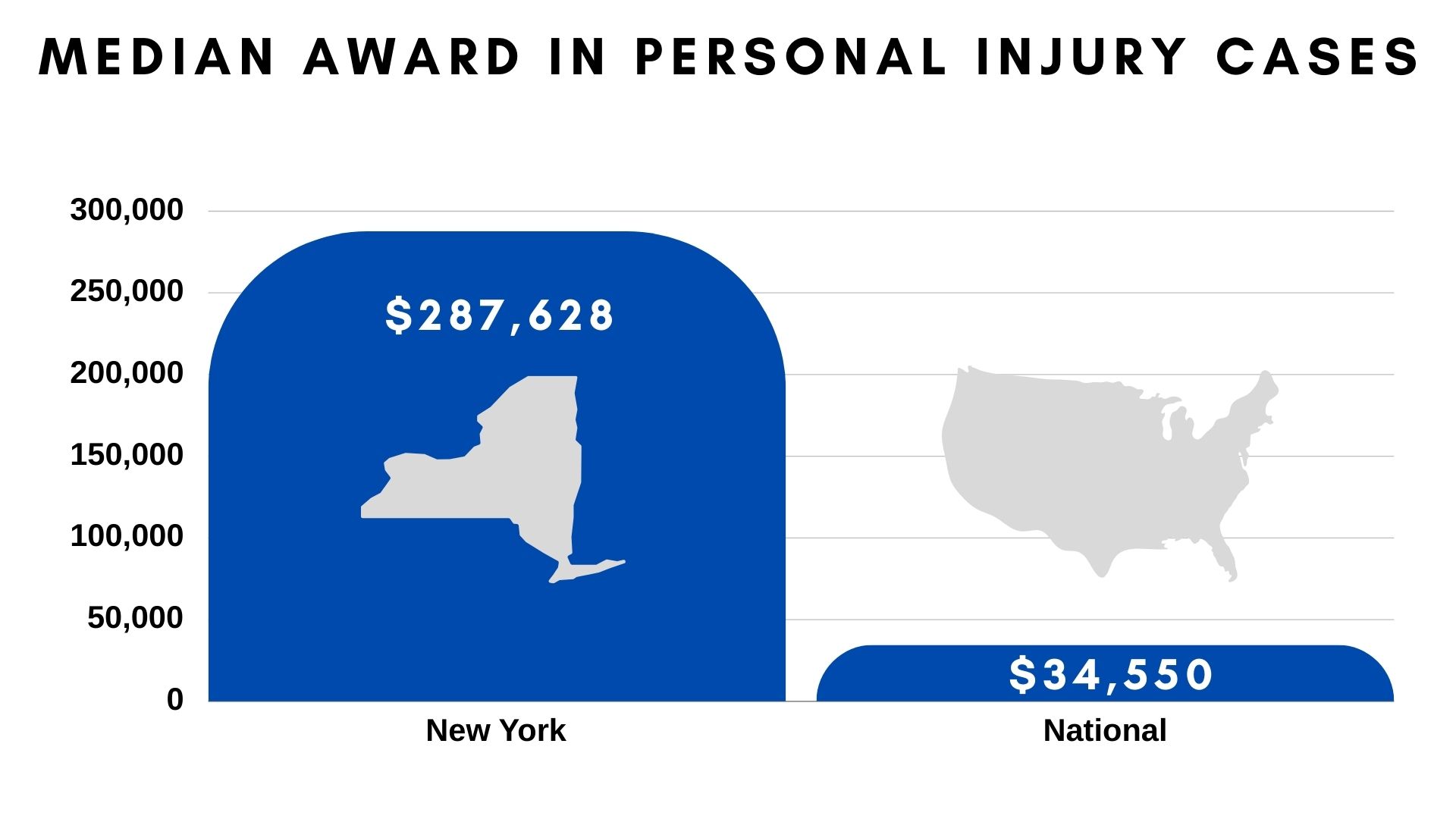
According to a study on jury verdicts, the median compensatory damages award for personal injury trials in New York is $287,628. This median award dwarfs the nationwide median of $34,550.
New York has favorable juries, particularly in its urban areas. But the reality is that the need for smaller and mid-sized car accident lawsuits distorts this number. Under New York’s no-fault law, an insurance company is required to pay drivers, passengers, and pedestrians up to $50,000.00 for their legitimate economic and medical losses but does not provide for pain and suffering.
Only permanent injury cases can recover more than $50,000. This leads to fewer lawsuits in smaller cases – of which there are many – which increases the overall award in New York. Remember that the typical settlement or verdict tells you very little about your claim’s expected settlement compensation payout.
Below, I summarize recent reported settlements and verdicts in New York auto accident cases. These cases should be used only for informational purposes and not as a guarantee of your settlement payout. But while they cannot calculate the settlement amount of your case, these stores are a tool to understand compensation values in personal injury cases better.
Here are some older verdicts we posted before we updated the page. These stories still teach lessons on the settlement value of New York injury claims.
New York has a “sort of” no-fault car insurance statutory scheme for handling car accident claims. This means – for minor accidents, at least – each driver’s own insurance policy will pay for their medical expenses and lost wages, regardless of who was at fault for the accident.
Under New York’s no-fault system, drivers must carry a minimum amount of no-fault insurance coverage. This coverage is intended to provide quick and efficient payment for medical expenses and lost wages following a car accident. The minimal coverage is not much:
The exact minimum coverages apply to uninsured motorist claims.
No-fault insurance does not cover pain and suffering or compensation. So small personal injury car accident lawsuits are not eligible for pain and suffering damages.
To get pain and suffering damages in a New York car accident, the injured party must prove a “serious injury.” A “serious injury” is defined as any of the following:
The last three are usually the battlefield in litigation.
The statute of limitations for personal injury cases in New York is generally three years. This means that a person who has suffered a personal injury has three years from the injury to file a lawsuit in court.
After the three-year period has passed, the person may be unable to file a lawsuit to seek compensation for their injuries. But call a lawyer. Because you cannot trust the general three-year deadline rule. The statute of limitations can vary for different types of personal injury cases and for different types of damages.
For example, if you rely on a three-year statute of limitations in a wrongful death claim, you may miss the two-year deadline for wrongful death claims because they must be filed within two years of the victim’s death.
You may also get it wrong in the opposite direction as well. For example, the statute of limitations may be tolled for minors until they turn 18, and the statute of limitations may not begin to run from the date the injury was or should have been discovered. But there are exceptions to the exceptions… the bottom line is to call a lawyer, even if only for a free consultation.
In New York, a statute of repose is a legal term that refers to a time limit on the right to bring a lawsuit. New York has diferent statutes of repose for different torts, which set an outer limit on the length of time during which an action may be brought, regardless of when the cause of action accrued. In other words, the discovery rule cannot save the plaintiff.
In New York, the statute of repose for product liability claims, for example, is ten years from the product’s sale or delivery date. After that time, a plaintiff is generally barred from bringing a claim for injury caused by the product, regardless of when the injury occurred. Are there exceptions? As with every statute of limitations or statute of repose, you can fill an encyclopedia with the exceptions. Whatever your case is, do your research and call a New York lawyer so they can tell you how the law applies to you.
Medical malpractice cases in New York generally require an expert witness to testify that the healthcare provider breached the standard of care. New York Civil Practice Law & Rules (CPLR) Section 3012-a requires expert witness testimony in a medical malpractice lawsuit in New York if:
Therefore, an expert witness may be necessary in medical malpractice cases to provide testimony about the standard of care that a healthcare provider should have followed, and whether the defendant deviated from that standard, causing harm to the plaintiff.
Section 3012-a also requires an expert’s affirmation. This is a sworn statement from a qualified medical expert attesting to the merit of the plaintiff’s claim. This affirmation must be filed with the medical malpractice lawsuits and the expert’s qualifications must be set forth. It cannot be speculative or conclusory. It must also include the following:
New York courts have found that a physician does not have to specialize in a specific field to be recognized as a medical expert. Any claimed deficiencies in specific knowledge areas affect the credibility and significance of the testimony rather than its eligibility for admission. But malpractice lawyers are always better off finding an expert that truly matches the case.
Punitive damages are damages awarded in a personal injury lawsuit as a form of punishment for the defendant’s conduct. Under New York law, punitive damages are “intended as punishment for gross misbehavior for the good of the public and have been referred to as “a sort of hybrid between a display of ethical indignation and the imposition of a criminal fine.”
Punitive damages are a great weapon in any New York personal injury lawsuit. But the bar for punitive damages is high. The plaintiff must first establish that the defendant’s conduct was malicious, fraudulent, or so reckless or outrageous that it demonstrated a conscious disregard for the rights of others (also called willful and wanton).
New York law prohibits insurers from paying punitive damages in wrongful death lawsuits. A bill reversing this law was proposed in Albany last year in 2023, but it did not pass.
When determining the amount of punitive damages to be awarded, the court considers several factors, including the
Judges are gatekeepers on punitive damages which means they can overrule the jury. So even when the plaintiff proves to the jury that the defendant’s conduct was outrageous, the court has the discretion to veto to jury’s decision, and the law insulates the judge on appeal of the decision to nullify the jury’s award.
In New York, comparative negligence determines a person’s compensation in a personal injury case. This legal principle holds that if an individual is partially at fault for an accident, they may still be entitled to recover damages, but the amount they receive will be reduced by their degree of fault.
Under New York’s pure comparative negligence law, an injured party can recover damages even if they are 99% at fault for the accident. However, their recovery will be reduced by their degree of fault. For example, if an individual is awarded $100,000 in damages but is found to be 50% at fault, they will only receive $50,000 in compensation.
It is important to note that in New York, the jury is responsible for determining the degree of fault for each party involved in an accident. The judge will instruct the jury to consider the actions of all parties involved and assign a percentage of fault to each person based on their level of responsibility for the accident.
Our firm handles serious injury and wrongful death lawsuits in New York, working with trusted friends and colleagues in New York. We compensate local lawyers out of our attorneys’ fees. You pay no additional contingency fees for having two law firms instead of one. And you only owe a fee if you get settlement compensation or a jury payout for you.
If you were hurt and believe you have a potential civil tort claim, click here for a free no-obligation consultation or call us today at 800-553-8082.
Comments are closed.


Personal injury lawyers handling serious personal injury truck and auto accident, medical malpractice and products liability cases throughout the United States.
This site is protected by reCAPTCHA and the Google Privacy Policy and Terms of Service apply.
Please do not include any confidential or sensitive information in a contact form, text message, or voicemail. The contact form sends information by non-encrypted email, which is not secure. Submitting a contact form, sending a text message, making a phone call, or leaving a voicemail does not create an attorney-client relationship.
New York Average Personal Injury Settlements – Lawsuit Information Center Blog

Visited 4 times, 1 visit(s) today
[mc4wp_form id="5878"]