
This page looks at settlement amounts and jury payouts in personal injury cases in Indiana. Our lawyers also provide an analysis of Indiana personal injury law.
If you are a personal injury victim bringing a compensation claim in Indiana is only natural to want to know how much your case might be worth. Monetary compensation is what a personal injury or wrongful death case is ultimately about.
This page is designed to look at how personal injury cases have been resolved in Indiana and to give you the ability to match your claim with Indiana personal injury settlement statistics and example settlements and jury payouts.
Indiana juries are more likely to issue a plaintiffs’ verdict, at least according to a Jury Verdict Research report that found that plaintiffs win damages in 57% of Indiana jury trials. The median money award for personal injury trials in Indiana is $25,036.
The Indiana comparisons to the national data are interesting: plaintiffs receive damages in 48% of cases that go to trial. So Indiana is more likely to find for the plaintiff. But they award less: the national median is $40,000. (Remember, this is a median, not an average, which excludes, by definition, large verdicts.)
Statistics mislead – there are a thousand clichés to prove it, especially older statistics like these. Interstate comparisons are even more challenging because they are based on results created by different variables. States with higher thresholds to get a jury trial in the first place should – on average – be higher. But these statistics are still interesting.
In Indiana, the statute of limitations for personal injury cases is two years from the date of the accident or incident. This applies to most personal injury claims, including auto accidents, slip and falls, and product liability claims. Failing to file a lawsuit within this timeframe generally results in the court refusing to hear the case although the statute is extended beyond two years for minors.
A lawsuit seeking compensation for personal harm arising from child sexual abuse must be initiated within one of the following periods, whichever is later:
(1) within seven years from the date when the legal basis for the lawsuit (the cause of action) arises, or
(2) within four years after the individual no longer relies on the alleged perpetrator for their basic needs and support.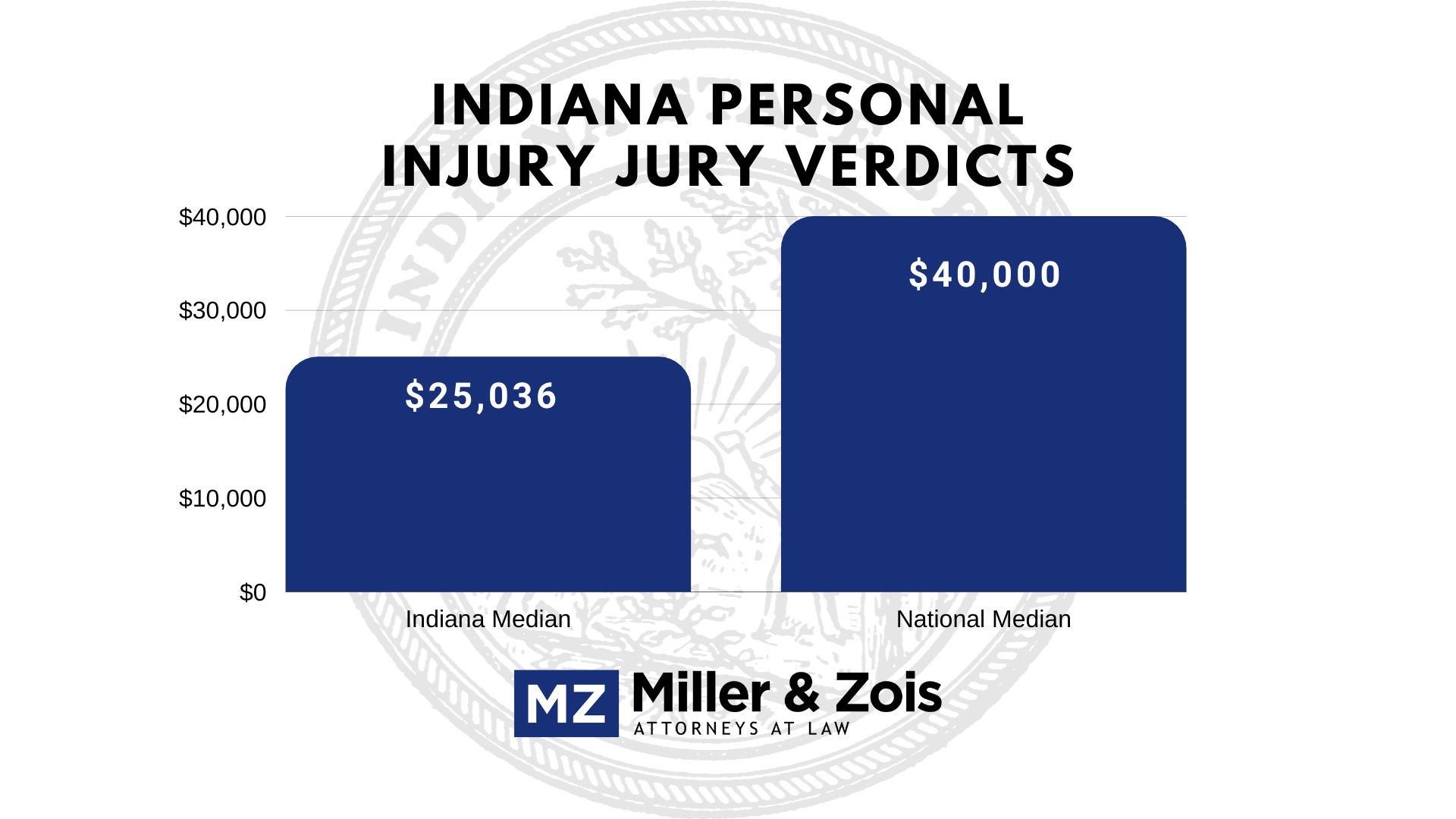
Let’s dig into the important rules in Indiana personal injury law.
The discovery rule stipulates that the statute of limitations commences not at the time of the offending act, but when the plaintiff becomes aware or could have become aware through reasonable diligence, that they have suffered harm due to tortious conduct. So under the discovery rule in Indiana, the statute of limitations starts to count only when the plaintiff becomes aware, or with reasonable diligence should become aware, of the wrongful act.
Of course, reasonable diligence is a battlefield in these cases. The cause of action doesn’t require full knowledge or determination of the entire extent of the damage, but merely that some discernible harm has taken place. The expected level of diligence equates to an expectation that an injured party will act promptly when the circumstances of an injury would alert an individual of average knowledge and experience that their rights have been violated or that a potential claim against another party might exist.
The statute of repose in Indiana is a legal provision that sets an absolute limit on the time period within which a plaintiff can bring a lawsuit, regardless of when the cause of action accrued. This means that after the specified period, no legal action can be initiated. It’s essentially a cut-off rule that aims to provide certainty and predictability in the law, protecting defendants from the threat of litigation after a reasonable period of time.
So, unlike the statute of limitations, the statute of repose puts an absolute limit on the potential liability of a defendant. Indiana’s Medical Malpractice Act includes a statute of repose, which states that no claim can be brought against a healthcare provider more than four years after the date of the alleged act or omission.
The Indiana Products Liability Act includes a ten-year statute of repose. This statute necessitates that a plaintiff initiate legal action within ten years from the date the product was delivered to the first user or consumer. The only deviation from this rule is for a legal claim that arises at least eight years but less than ten years after the product was initially delivered. In such cases, a plaintiff retains the right to file a lawsuit within two years from the date the claim accrued, even if this extends beyond the ten-year period since the product’s delivery. The statute does not provide for any other exceptions, meaning that the ten-year limitation period cannot be extended under any other circumstances, including post-sale actions taken by the manufacturer such as repair, refurbishment, or reconstruction of a product.
The Indiana comparative fault rule, often referred to as the modified comparative fault rule, reduces the amount of compensation a plaintiff can recover in a personal injury lawsuit if they are found to be partially at fault for their injuries. Moreover, if they are found to be more than 50% at fault, they can be barred from recovering any damages at all (Indiana Code § 34-51-2-6).
The Indiana Comparative Fault Act (IC 34-51-2) stipulates the conditions under which this rule is applied. According to this Act, in cases where the plaintiff’s fault is greater than the fault of all persons whose fault proximately contributed to the claimant’s damages, the claimant is not entitled to recover any compensatory damages. However, if the plaintiff’s comparative fault in Indiana is less than or equal to the combined fault of all other persons involved, the total amount of damages they are entitled to recover is reduced in proportion to the plaintiff’s fault.
The Comparative Fault Act mandates that the jury is responsible for allocating blame to individuals who played a role in causing the alleged injury. The concept of “fault” encompasses actions such as engaging in unreasonable risk-taking that does not constitute valid express consent, accepting risks, and failing unreasonably to prevent an injury or minimize damages.
The collateral source rule is a legal principle that addresses the compensation received by an injured party from sources other than the defendant in a personal injury case. The collateral source rule allows the injured party to retain the full amount of compensation received from these “collateral sources” without offsetting or reducing the damages awarded by the defendant.
The aim of the collateral source statute is twofold: first, to ascertain the true extent of financial losses incurred by the prevailing party and to prevent them from double-recovery, where they seek compensation from multiple sources for each loss in a personal injury or wrongful death lawsuit.
Second, it upholds the traditional legal principle that collateral source payments should not diminish a damage award if they stem from the victim’s proactive actions, including both personally acquired insurance and government benefits, typically because the victim has contributed to these benefits through taxation. This is outlined in Ind. Code Ann. § 34-44-1-2.
Under the collateral source rule, payments or benefits received by the injured party from sources such as insurance policies, health insurance, disability benefits, or other forms of compensation are generally not taken into consideration when determining the damages owed by the defendant. This means that the defendant cannot reduce their liability or damages owed based on the compensation the injured party has received from other sources.
Unfortunately, Indiana’s collateral source law is unfavorable to victims. The purpose of this statute is to prevent the plaintiff from recovering damages for which they have already received compensation from a third party instead of protecting victims who had the good sense to carry insurance. Indiana Code § 34-44-1-2 outlines the admission of evidence related to collateral source payments in personal injury or wrongful death actions. According to the statute:
The statute does not apply to payments made by an insurer under a policy purchased by the plaintiff or reimbursements by healthcare agencies administered through government programs.
Indiana’s Dram Shop Law, codified under Indiana Code 7.1-5-10-15.5, establishes the legal framework for holding individuals or entities responsible for damages caused by intoxicated persons whom they have furnished with alcoholic beverages. This statute applies universally, without distinguishing between commercial establishments (dram shops) and social hosts, making anyone who provides alcohol liable under certain conditions.
Specifically, liability arises when alcohol is furnished to a person that the defendant knew or should have known was an intoxicated person, and that person subsequently causes harm due to their impairment. The law aims to reduce alcohol-related injuries by encouraging responsible serving practices among those who provide alcohol, whether in a commercial setting or at private gatherings
To file a medical malpractice lawsuit in Indiana as required by Indiana Code section 34-18-8-4, a preliminary complaint for medical malpractice must be lodged with the Department of Insurance before any legal action is initiated in court. Plaintiffs cannot file an initial complaint to the Department of Insurance and later claim that the Act and its associated statute of limitations are not applicable. It’s important to note that the act of filing an initial complaint with the Department of Insurance doesn’t equate to the commencement of a lawsuit. This preliminary complaint to the Department of Insurance serves as a necessary precondition before taking any legal action in court, rather than being considered as the commencement of a legal action in itself.
The purpose of this law is to establish a structured process for handling medical malpractice claims, ensuring fairness and providing an opportunity for resolution before proceeding to court. The chapter includes provisions related to the formation of medical review panels, the filing of complaints, and the review and evaluation of medical malpractice claims. There is no question that Indiana law makes it onerous for medical malpractice victims to file a lawsuit. Here are the key points if you are looking to file an Indiana medical malpractice lawsuit:
Bear in mind that the Indiana Medical Malpractice Act outlines specific procedures that must be followed for filing medical malpractice claims against healthcare providers – but you have to be recognized as “qualified” under the Act or none of that applies.
According to Ind. Code § 34-18-3-1, for healthcare providers to be considered qualified under the MMA, they must adhere to the stipulations detailed in Ind. Code § 34-18-3, which includes making necessary contributions to the Patient’s Compensation Fund, thereby gaining access to the Act’s protective measures as described in Ind. Code § 34-18-2-24.5.
Medical malpractice claims directed at healthcare providers who do not meet these qualifications do not fall under the MMA’s scope of protection. Conversely, the Professional Services Statute has been applicable to malpractice claims against healthcare providers who do not qualify under the MMA since the MMA was established.
We talk more about sexual assault and abuse cases below. But, certainly, sexual groping does not serve a healing or beneficial purpose. Such behavior bears no relation to advancing a patient’s well-being or the application of a provider’s professional knowledge, competence, or discernment. So, sex abuse lawsuits against doctors are not subject to the MMA.
In a malpractice lawsuit in Indiana, expert witness testimony is generally required to establish the appropriate standard of care, demonstrate that it was breached, and prove causation. The expert is usually a healthcare provider practicing or teaching in the same area of healthcare as the defendant. Indiana Code Title 34, Section 23-9-3-6, states that in a medical malpractice lawsuit, the plaintiff must file an affidavit with the complaint, declaring that the plaintiff consulted with at least one healthcare provider who is knowledgeable in the relevant field of medicine and who has determined in a written opinion that there is a reasonable basis to believe that malpractice has occurred. This opinion must be attached to the affidavit.
We have been talking about how Indiana makes protecting doctors from their own negligence a priority. For wrongful death and catastrophic injury victims with a malpractice claim, the Indiana medical malpractice cap might be the single biggest obstacle to justice. Indiana Code § 34-18-14-3 limits non-economic damages in medical malpractice cases to $1.8 million. So even a birth injury lawsuit where the damages can be in the tens of millions. For claims that arise after June 30, 2019, the cap is set at $1,800,000.
Indiana makes it even easier for doctors and hospitals. Any excess amount beyond the total liability of all liable healthcare providers is paid from a state-run patient’s compensation fund.
Another malpractice cap in Indiana is on attorneys’ fees: 32%.
Indiana medical malpractice cases have the same two-year statute of limitations. However, there can be exceptions, especially involving minors or when the injury isn’t immediately discoverable. When the injury is discovered within this two-year window, the victim has a further two years to file a claim.
According to the Indiana Medical Malpractice Act’s (IMMA) statute of limitations, minors who have been victims of malpractice are required to lodge their claims either (1) within two years from the date of the injury, or (2) by their eighth birthday if the injury took place before they turned six years old.
Indiana has a unique system in place to help those who have suffered significant damages due to medical negligence—the Indiana Patient’s Compensation Fund (IPCF).
When a patient believes they have been a victim of medical malpractice by a healthcare provider, they have the option to file a lawsuit. Most healthcare providers in Indiana are required to carry medical malpractice insurance, which covers them in case they are found liable for medical malpractice, and are required to pay damages to the injured patient.
But what happens when the damages awarded to the injured patient exceed the healthcare provider’s insurance coverage limits? In Indiana, you can turn to the IPCF. The IPCF is a state-operated fund created to provide additional compensation to patients who have suffered significant damages due to medical malpractice.
To access the IPCF, patients must meet specific eligibility criteria. These criteria may include exceeding certain damage thresholds or demonstrating that the healthcare provider’s liability exceeds their insurance coverage. Patients may need to file a separate petition or claim with the IPCF, in addition to their lawsuit against the healthcare provider.
If the IPCF determines that the patient’s case qualifies for additional compensation, they may negotiate a settlement or make an award to the patient. This additional compensation is intended to cover the excess damages beyond what the healthcare provider’s insurance covers.
Healthcare providers who participate in the IPCF program are required to pay annual assessments into the fund. These assessments help fund the IPCF and cover the costs of providing additional compensation to patients. So in individual malpractice cases, physicians bear the initial responsibility for covering damages up to $250,000, as per the state’s cap. Any remaining damages, not exceeding $1 million, are then covered by the state Patient’s Compensation Fund.
The most recent data on how much compensation the IPCF has disbursed is a few years old. But for some context, the fund disbursed a total of $115.5 million in 2020 to settle over 150 claims, resulting in an average compensation payout of approximately $740,000 per claim.
Under Indiana law, physicians have a duty to disclose all significant medical information that a reasonable person would want to know to make an informed decision about their treatment. According to Indiana Code § 34-18-7-1, healthcare providers have a duty to disclose relevant information to patients, including the nature of the proposed treatment, potential risks and benefits, alternative treatments, and the likely outcome of each option. The information disclosed must be presented in a manner that the patient can understand, allowing them to make an informed decision about their healthcare.
Informed consent in Indiana requires more than mere verbal or written consent; it necessitates a meaningful dialogue between the healthcare provider and the patient. Healthcare providers should encourage patients to ask questions, address their concerns, and provide additional information as needed. This process fosters a collaborative relationship between the patient and the healthcare provider, ensuring that the patient’s values, preferences, and individual circumstances are taken into account.
In some cases, obtaining informed consent requires written documentation. Indiana Code § 34-18-7-2 stipulates that certain medical procedures, such as surgical interventions or experimental treatments, must be documented in writing. This written consent serves as evidence that the patient was adequately informed and voluntarily consented to the procedure.
Indiana’s dog bite law holds owners liable if their dog bites someone unprovoked, and the person bitten was acting peaceably and was in a location they were legally allowed to be. Indiana Code § 15-20-1-3 expresses this strict liability standard that holds dog owners responsible for injuries caused by their dogs, regardless of the dog’s previous behavior or the owner’s knowledge of such behavior. Here is a summary of the key points of Indiana’s dog bite law:
In Indiana, victims of child sexual abuse have until the age of 31 to file a civil lawsuit. For sexual abuse discovered in adulthood, victims have seven years from the date of discovery to file a claim. Here are the specific rules for civil sex abuse lawsuits in Indiana:
In Indiana, the personal representative of the deceased’s estate can file a wrongful death lawsuit. The statute of limitations for these claims is two years from the date of death. Damages in wrongful death cases may cover loss of love and companionship, loss of earnings, funeral and burial expenses, and medical and hospital expenses.
Indiana Code § 34-23-1 establishes the legal framework for seeking compensation when a person’s death is caused by the wrongful or negligent act of another party. This law allows for a civil lawsuit to be filed in such cases. Only the personal representative of the deceased person’s estate has the authority to initiate a wrongful death claim in Indiana on behalf of the wrongful death beneficiaries. The personal representative is typically appointed through the probate court process. The Indiana wrongful death statute of limitation is two years.
Like many states, Indiana law also allows for a separate cause of action called a survival action. This allows the personal representative to bring a lawsuit on behalf of the deceased person’s estate for any personal injury, pain, and suffering the deceased experienced before their death.
Premises liability law governs incidents where a person is injured on another person’s property. In Indiana, property owners have a duty of care to maintain safe premises for visitors.
It is a well-established principle that a property owner is obligated to provide reasonable care for the safety of an invitee while they are present on the property. This duty of care includes a consideration of the foreseeability of harm, a factor which the courts determine as part of their duty analysis.
If the owner fails to uphold this duty and an injury occurs, they may be held liable.
Indiana is a “fault” state in car accident cases. This means the person responsible for causing the car accident is also responsible for any resulting harm and damage. The comparative fault rule also applies to car accident cases, meaning damage recovery will be reduced in proportion to the injured party’s degree of fault.
The concept of fault encompasses the unreasonable taking on of risk that does not amount to legally binding express consent, the acceptance of risk, and the unreasonable neglect to prevent an injury or to reduce the severity of damages.
Minimum insurance coverage is not great in Indiana for victims: $25,000 for bodily injury per person, $50,000 for bodily injury per accident, and $25,000 for property damage.
The Indiana Tort Claims Act (ITCA), specifically governed by Indiana Code §§ 34-13-3 for claims against local governmental entities and Indiana Code § 34-13-3-6 for claims against the state, establishes the legal framework for bringing tort claims against governmental bodies in Indiana. This Act requires individuals seeking to file a tort claim against a local government or the state to adhere to specific notice provisions, which are pivotal in maintaining the claim’s viability.
For claims against local governmental entities, the ITCA necessitates that a claimant provide written notice of the claim to the governmental entity within 180 days of the incident. This notice must contain specific information about the incident, including the conduct and circumstances that brought about the loss, the time and place where the loss occurred, and the names of those involved, if known. The purpose of this notice is to ensure that the governmental entity is adequately informed of the claim and has an opportunity to investigate the allegations promptly.
For claims against the state of Indiana, the procedure is slightly different. Indiana Code § 34-13-3-6 stipulates that claimants must file a notice of their claim with the Indiana Attorney General’s Office within 270 days of the incident. Similar to claims against local entities, this notice must detail the incident’s specifics, enabling the state to conduct a thorough investigation.
Failure to comply with these notice requirements will almost certainly lead to a claim being barred. You need to understand and follow the text of ITCA’s provisions (not just reaching online). The notice period allows the governmental entity or the state to investigate the claim and potentially resolve it without litigation, serving as a critical preliminary step in the legal process for tort claims against governmental bodies in Indiana. The laws are often confusing – call an Indiana lawyer to get it straight.
Under Indiana law, a manufacturer or seller of a product can be held responsible if that product is defective and that defect causes harm.
There are a number of national mass torts or “class actions” that involve Indiana plaintiffs, including claims our law firm is handling across the country:
Our firm handles serious injury and wrongful death lawsuits in Ohio, working with trusted colleagues in Indiana. We compensate your Indiana lawyers out of our attorneys’ fees. You pay no additional contingency fees for having two law firms instead of one. And you only owe a fee if you get settlement compensation or a jury payout for you.
If you were hurt and believe you have a potential civil tort claim, click here for a free no-obligation consultation or call us today at 800-553-8082.


Personal injury lawyers handling serious personal injury truck and auto accident, medical malpractice and products liability cases throughout the United States.
This site is protected by reCAPTCHA and the Google Privacy Policy and Terms of Service apply.
Please do not include any confidential or sensitive information in a contact form, text message, or voicemail. The contact form sends information by non-encrypted email, which is not secure. Submitting a contact form, sending a text message, making a phone call, or leaving a voicemail does not create an attorney-client relationship.
Indiana Personal Injury Law – Lawsuit Information Center Blog

Visited 4 times, 1 visit(s) today
[mc4wp_form id="5878"]